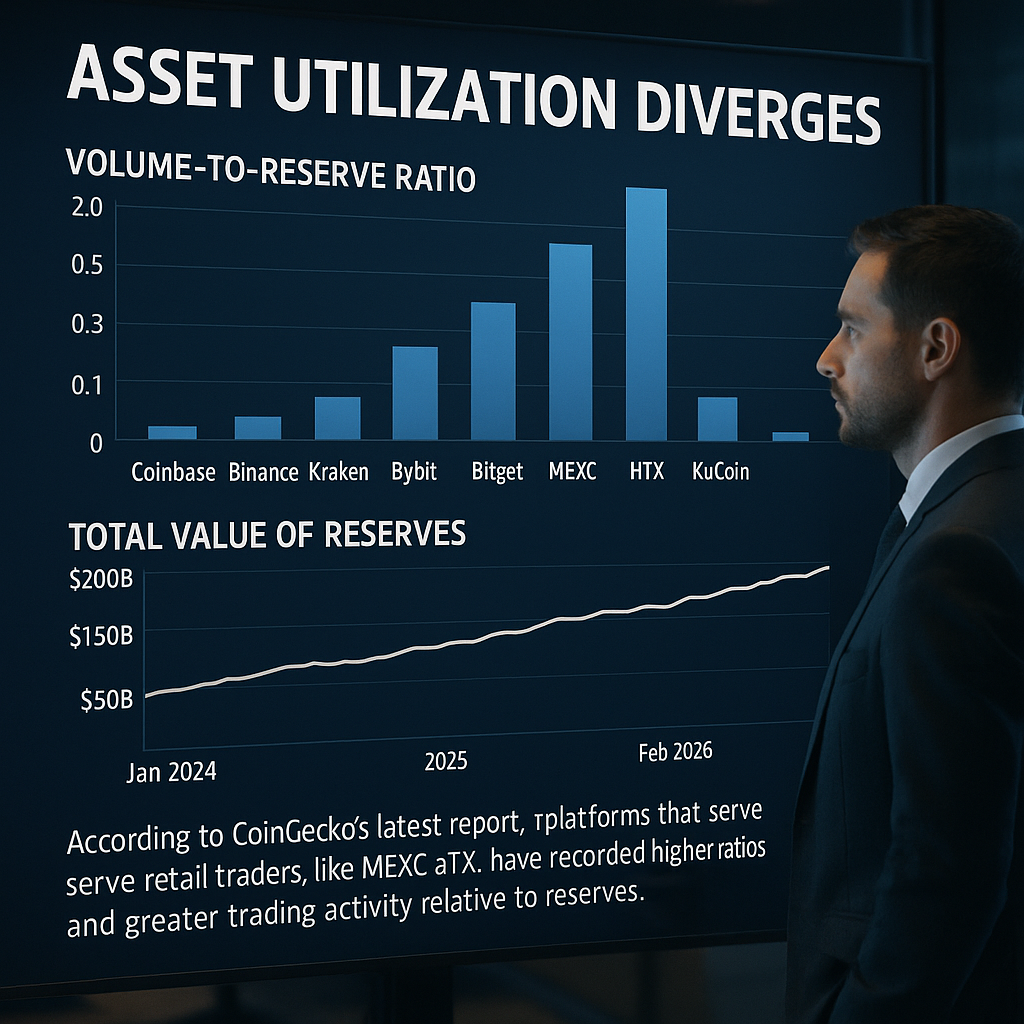
Retail-oriented exchanges utilize a greater proportion of their reserves for trading compared to their institution-oriented counterparts. Platforms with a stronger institutional focus, such as Coinbase, Binance, and Kraken, exhibit relatively low volume-to-reserve ratios of approximately 0.1, which suggests that deposits are primarily retained rather than actively traded. According to CoinGecko’s latest report, exchanges targeting retail traders, like Bybit and Bitget, see higher average ratios between January 2024 and February 2026, registering between 0.3 and 0.5, indicative of increased trading activity. Meanwhile, crypto exchanges with smaller reserve pools, such as MEXC, HTX, and KuCoin, report significant asset velocity, ranging from 1.44 to 2.04, reflecting heavier trading volumes in relation to available reserves. In addition to trading activity disparities, CoinGecko notes that the total asset value across the top 12 centralized platforms surged nearly 70%, rising from $152.1 billion at the beginning of 2024 to $225.4 billion by February 2026. During this period, eight exchanges experienced net growth, with Binance at the forefront, seeing its reserves double in size. Meanwhile, Coinbase continues to hold the largest Bitcoin reserves, exceeding 800,000 BTC, closely followed by Binance. Despite this, Coinbase has faced substantial outflows in both Bitcoin and Ethereum, with some of these funds seemingly shifting to smaller platforms, as evidenced by Bitget and MEXC’s notable increases in reserve value. Additionally, the report highlighted weak post-listing performances among major exchanges, with only about 32% of newly listed tokens remaining above their listing price within the first 30 days. Upbit distinguished itself with the strongest early results, boasting that around 67% of its listings remain profitable, though it lists fewer tokens overall. Binance and OKX follow, each with approximately 50%. However, the gains typically diminish rapidly; by 30 to 60 days, only about a quarter of tokens sustain positive returns. Over longer intervals, this share declines across most platforms, with Coinbase emerging as an exception where some tokens have recovered after six months. Ultimately, by the end of one year, fewer than 10% of listed assets on the majority of exchanges stay above their initial listing prices.